Not knowing what to expect at the dentist is one of the most common reasons people put off going. If you’ve moved to Mawson Lakes from overseas, or if it’s simply been a few years since your last visit, the whole process can feel a bit opaque. This post walks through exactly what happens during a routine dental check-up at Smile Spot — step by step, no surprises.
Why predictability matters
A lot of our patients are professionals working at Technology Park Adelaide or Edinburgh RAAF base, students from UniSA’s Mawson Lakes campus, and families juggling school pickups across Parafield Gardens, Ingle Farm, and Paralowie. Time is genuinely tight. Knowing that a check-up takes roughly 45 minutes from arrival to walking out the door — and knowing exactly what fills those 45 minutes — makes it a lot easier to actually schedule one.
We’re open Monday to Thursday until 7pm, which means patients can catch us on the Gawler line after work, hop off at Mawson Interchange, and walk over to Coventry Street. Families in Para Hills, Pooraka, and Salisbury often book straight after the school run rather than taking time off work. Friday appointments run from 9am to 2pm for those who can flex their schedule mid-week. That evening availability is intentional — we built our hours around how this suburb actually lives.
Arriving and checking in
When you arrive at 1/3 Coventry Street — right near The Promenade Shopping Centre — our reception team will greet you and confirm your details. If it’s your first visit, you’ll fill out a short medical history form covering medications, allergies, past surgeries, and any conditions that might affect treatment, things like diabetes, blood thinners, or heart conditions.
For patients who’ve moved to Australia from Vietnam, India, China, Korea, or elsewhere, the local dental system can feel unfamiliar. The check-up and clean model, what private health insurance covers, how gap payments work — these take some getting used to. Dr Louise Chen speaks Mandarin, Dr Sunny speaks Punjabi, and I (Dr Alissa Kim) speak Korean. In a community where 42.5% of residents were born overseas, we see answering those questions in your own language as part of the job, not an add-on. If it’s easier to ask something in Mandarin, Punjabi, or Korean, please do.
Existing patients just confirm whether anything has changed since their last visit. Either way, check-in takes a couple of minutes.
The clinical examination
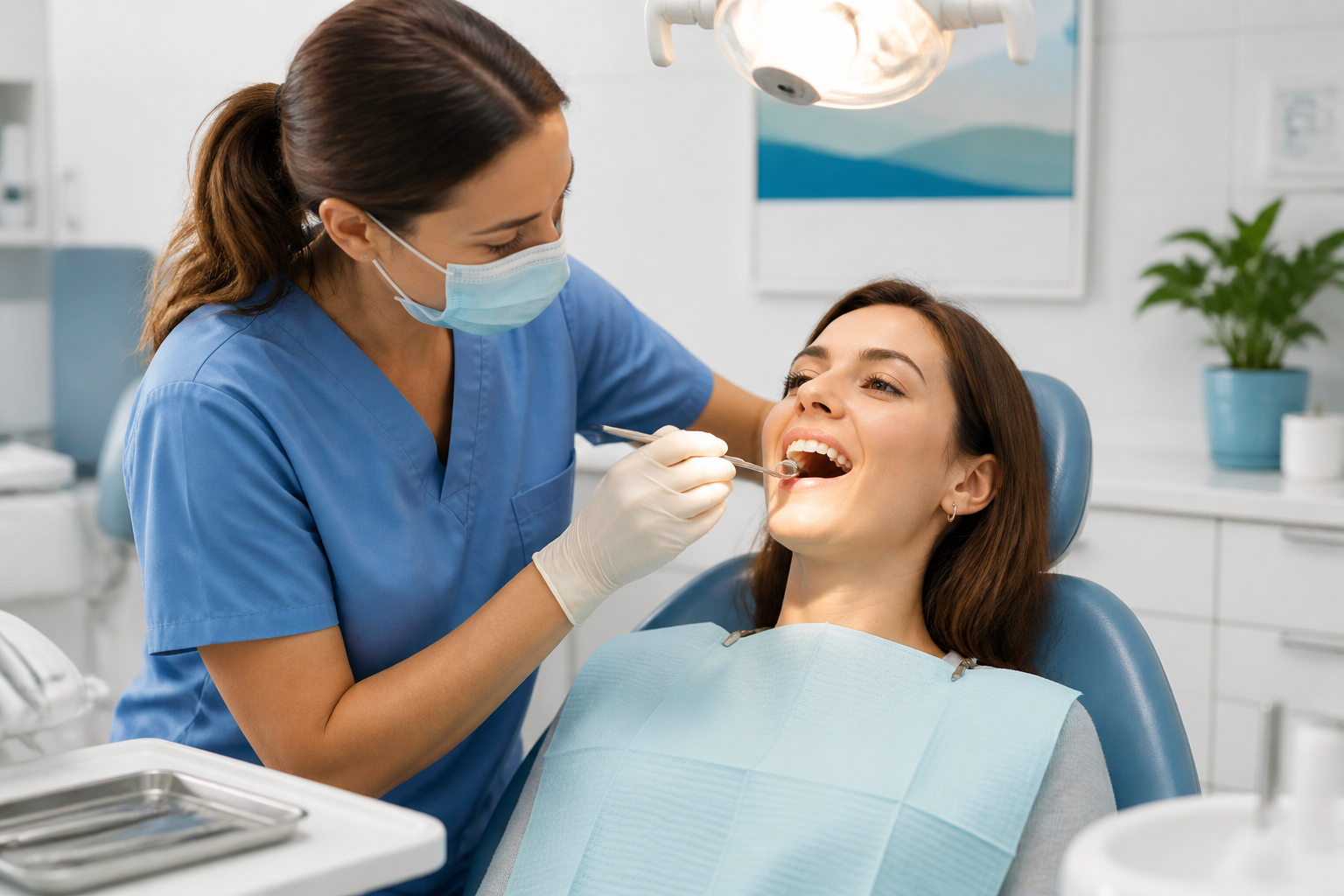
Once you’re in the chair, the examination begins. This is more thorough than most people expect — it covers several different areas, not just a quick look at your teeth.
Teeth. We check each tooth for decay, cracks, wear, and the condition of any existing fillings or restorations. Early decay often has no symptoms at all, which is the whole point of catching it before it becomes a problem. A small filling now is a far better outcome than a same-day crown or extraction further down the track. Dr Sunny, our principal dentist and an implants and orthodontics specialist, handles more complex cases if any prior restorations need close assessment.
Gums. We look at colour, firmness, and whether there’s bleeding or swelling. Using a small probe, we measure the depth of the pockets around each tooth. Deeper pockets indicate gum disease — one of the most common and underdiagnosed conditions in Australian adults. Preventive and restorative care is an area Dr Louise Chen is particularly focused on, and gum health is often where that conversation starts.
Soft tissues. Your dentist examines the tongue, cheeks, palate, floor of the mouth, and throat. This is an oral cancer screening — we’re looking for unusual patches, lumps, or tissue changes. It takes under a minute and it’s one of the parts of a check-up most patients don’t realise is happening.
Bite and jaw. We check how your teeth come together and look for signs of grinding or jaw issues. Worn-down teeth, unexplained chips, and jaw clicking can all point to nighttime grinding — particularly common among people under sustained workload pressure. We see it regularly in Defence and tech sector professionals from Edinburgh RAAF and Technology Park, and it’s worth picking up early before it causes structural damage.
Digital x-rays
Not every visit requires x-rays, but when they’re needed, we use digital x-rays rather than traditional film. Digital x-rays produce significantly less radiation than conventional x-rays and deliver results almost instantly — the image appears on screen within seconds. That means we can show you exactly what we’re looking at in real time, rather than asking you to come back for results.
We typically take a baseline set on your first visit so we have something to compare against future visits, then periodically — usually every one to two years — depending on your risk profile. X-rays let us detect decay between teeth that isn’t visible to the eye, assess the bone levels around your teeth, and investigate anything the clinical exam raises. They’re a routine part of thorough preventive care, not something to be concerned about.
Scale and clean
After the examination, the scale and clean removes plaque and tartar — the hard deposits that form on teeth over time and can’t be removed by brushing alone, no matter how dedicated you are. An ultrasonic scaler breaks up deposits using vibrations and water, followed by hand instruments for finer detail. Your teeth are then polished to smooth the surfaces and remove surface staining.
If it’s been a while between appointments, there may be more buildup than usual. That’s completely fine — we see this regularly, and there’s no judgement involved. It just means the clean takes a little longer. For parents bringing children to their first or second clean, I take extra time to make sure the experience is calm and positive. A good early experience at the dentist pays dividends for the next 20 years.
Fluoride treatment
For patients who’d benefit from additional enamel protection — children, patients with a history of decay, or anyone we assess as higher risk — we apply a fluoride varnish after the clean. Quick, painless, and the only instruction afterward is to avoid eating or drinking for 30 minutes.
Treatment plan discussion
Once the examination and clean are complete, we talk through what we found. If treatment is needed, we explain what it is, why it’s recommended, what the options are, and what it’s likely to cost. If nothing needs doing, we say so clearly.
When multiple things need attention, we work through them in order of urgency. A phased approach is normal and often the most practical way forward — we’ll never pressure you into starting something before you’re ready. Our general dentistry page gives an overview of treatments and what they typically involve.
If your child or you are nervous about coming in
Around 48.4% of households in the Mawson Lakes area have at least one child under 15, and children’s first dental visits are something we see a lot. A child’s appointment with me is slower, more conversational, and very different from a standard adult appointment — no rush, plenty of explanation. Families from Ingle Farm, Parafield Gardens, Pooraka, and Salisbury are welcome to ask about our approach when they book.
Dental anxiety in adults is equally common. If you’re nervous, let us know — we allow extra time and adjust accordingly. You can read more about how we support nervous patients.
Health funds, HICAPS, and payment plans
We’re a Bupa Members First Platinum provider and a preferred provider for nib, CBHS, and smile.com.au. For eligible extras cover holders, routine check-ups and cleans are often fully covered with no out-of-pocket cost.
For all other major health funds, we process claims on the spot through HICAPS — you pay the gap (if there is one) rather than paying the full amount and waiting for a rebate. No forms, no waiting, no chasing the fund afterward. In a suburb where many households hold private health insurance, that instant processing makes a real difference to how people experience the visit.
For patients without health cover, or for more significant treatment, we offer DentiCare interest-free payment plans so that cost doesn’t become a barrier to getting care you need. We’re also QIP accredited — an independent quality and safety certification covering our clinical care, infection control, and patient communication standards.
How often should you come back?
For most adults, every six months — though the right interval depends on your individual risk profile and your dentist will advise after the first visit. For a fuller discussion, read our post on how often you should visit the dentist. The short version: problems caught early are smaller, simpler, and less expensive to treat. A check-up is the most effective thing you can do for your long-term dental health.
Come and see us
Smile Spot Mawson Lakes is at 1/3 Coventry Street, Mawson Lakes SA 5095, right near The Promenade Shopping Centre and a short walk from Mawson Interchange. We’re easily accessible for patients travelling on the Gawler rail line, and within a comfortable drive for families across Parafield Gardens, Paralowie, Salisbury, Ingle Farm, Para Hills, and Pooraka. Evening appointments until 7pm Monday to Thursday, and Friday hours from 9am to 2pm, mean you can fit a check-up around work, study, or the school run.
Book at Smile Spot — call (08) 8258 0650 or book online.