A custom mouthguard from your dentist protects your teeth significantly better than anything you’ll find at the chemist or supermarket. That’s not a sales pitch — it comes down to fit, material thickness, and the simple fact that a mouthguard you can actually breathe and talk in is one you’ll actually wear.
Here in Mawson Lakes and across Adelaide’s northern suburbs, we see a lot of families with kids deep into sport. Junior AFL clubs in Parafield Gardens and Salisbury, basketball competitions through the Para Hills and Ingle Farm networks, cricket and hockey through the school sport programs — if your child is playing any contact or collision sport, there’s a good chance a mouthguard is either required or strongly recommended by their club or school. It’s worth understanding what you’re actually getting with the one they’re wearing.
Why mouthguards matter in the first place
Dental injuries are among the most common sports injuries, particularly in contact and collision sports. A knocked-out adult tooth is a dental emergency that requires immediate treatment — and even with prompt care, reimplantation isn’t always possible. Replacing a missing tooth with a dental implant can cost $3,000 to $6,500. A cracked tooth may need a crown. Dental injuries in children and teenagers can have consequences that follow them for decades — both functionally and aesthetically.
A well-fitted mouthguard absorbs and distributes impact force before it reaches your teeth, gums, and jaw. It also provides a small degree of protection against concussion by cushioning the jaw during a direct impact to the face.
The question isn’t whether to wear a mouthguard. The question is which kind.
The three types of mouthguards
Stock mouthguards are the pre-formed, ready-to-wear guards you find in the sporting goods aisle or at the chemist — typically $15 to $30. Because they come in only a few sizes and aren’t shaped to any individual’s teeth, they tend to fit poorly. Most people have to clench their teeth to hold them in place, which makes breathing and talking during play genuinely difficult. These offer the least protection of any option.
Boil-and-bite mouthguards are a step up. You soften the thermoplastic material in hot water, then bite into it to create a rough impression of your teeth. The fit is better than stock guards, and they’re available at most sporting goods stores for $30 to $60. The limitation is that the impression-taking process is imprecise — especially for kids trying to do it themselves — and the material tends to be thinner in high-impact areas.
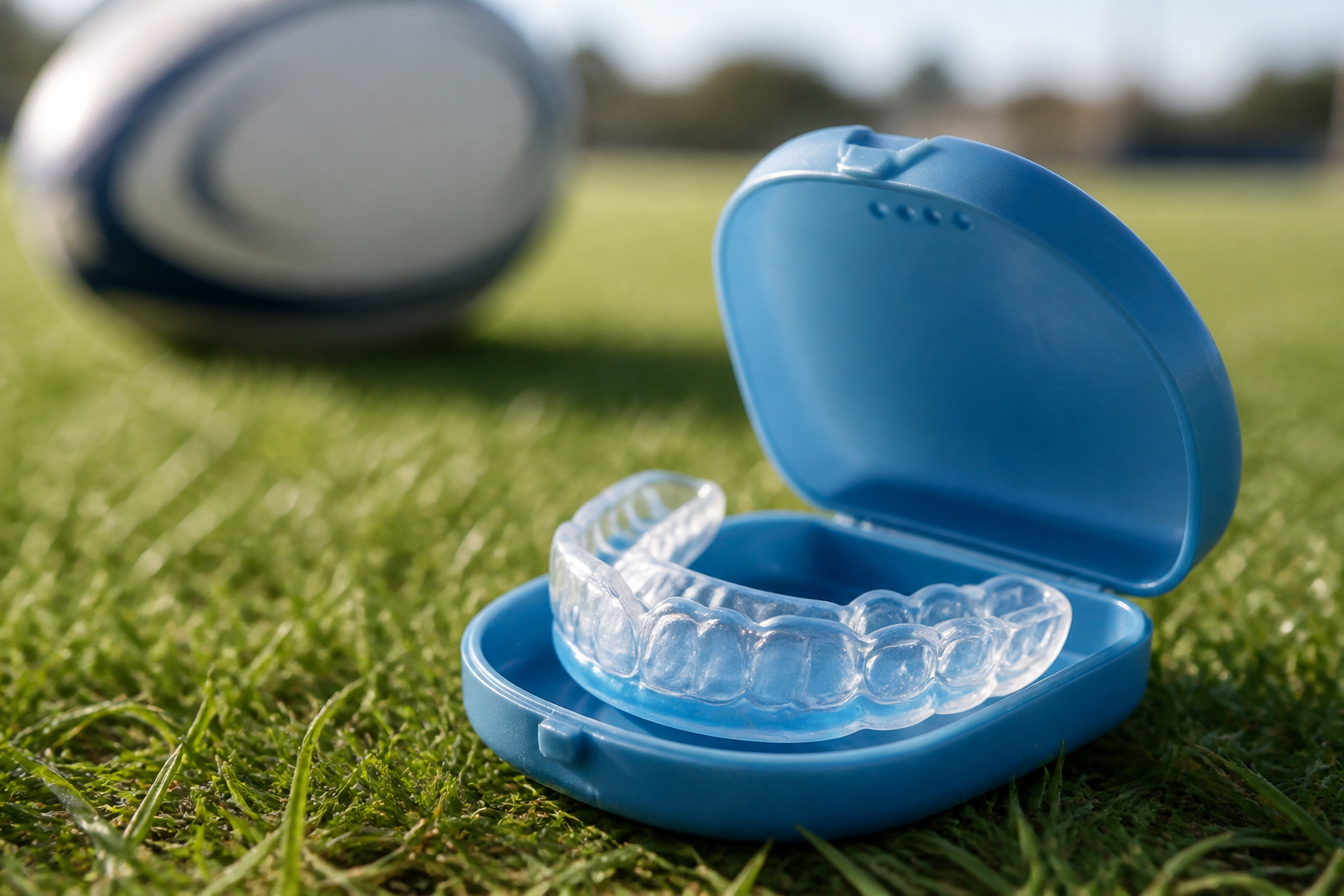
Custom-fitted mouthguards are made by a dental practice from a precise impression of your teeth. The finished product is designed specifically for your mouth, your bite, and the sport you play. It stays in place during activity without clenching, allows normal breathing and communication, and provides consistent thickness and coverage across the areas most likely to take impact.
How a custom mouthguard is made
The process at Smile Spot Mawson Lakes is straightforward. Your dentist takes an impression of your upper teeth — a quick, non-invasive process that takes a few minutes. That impression goes to a dental laboratory, which fabricates the guard from a durable, high-grade thermoplastic material. The finished guard comes back within about a week, and your dentist fits and adjusts it to ensure proper coverage and comfort.
The result is a guard with consistent material thickness across the entire protective surface, a snug fit that doesn’t shift during play, and enough comfort to wear for the full length of a match or training session.
Why fit matters more than most people realise
The single biggest failing of cheap mouthguards is that they don’t stay in place. A guard that falls out mid-play — or that the wearer keeps removing because it’s uncomfortable — offers no protection whatsoever.
Beyond simply staying in place, a well-fitted guard distributes impact force more evenly across the arch. An ill-fitting guard that shifts on impact can actually concentrate force in one spot rather than dispersing it — potentially increasing the risk of injury rather than reducing it.
This matters especially for junior players. A boil-and-bite that fits awkwardly at the start of the season often fits worse by mid-season as the child grows, as teeth move, or simply as the material continues to soften and deform with use.
Adelaide’s football culture and what it means for your kids’ teeth
South Australia’s relationship with AFL is serious, and that enthusiasm flows all the way down to junior competition. The SANFL juniors are the feeder pathway that many Mawson Lakes and northern suburbs families are involved in — and SANFL junior player guidelines are clear that mouthguards are required for junior competition in contact sports.
The Adelaide Crows and Port Adelaide both promote mouthguard use through their junior development programs. But at the junior club level across Parafield Gardens, Salisbury, and the surrounding suburbs, the type of guard worn is often left to families to sort out — which is exactly where the gap opens up between good intentions and adequate protection.
The same applies to school sport. SA school sport policies increasingly specify that mouthguards must be worn for contact activities, but the rules don’t always specify custom versus store-bought. A $15 stock guard technically meets the requirement. Whether it provides meaningful protection is a different question.
Weekend sport here is a big part of community life — the reserves around Mawson Lakes, the ovals in Parafield Gardens, the courts and turf in Salisbury are busy on Saturday mornings. If your family is part of that, it’s worth making sure the gear your kids wear is actually doing its job.
Replacing kids’ mouthguards as they grow
This is something families sometimes overlook: children’s mouths change. As teeth erupt, jaws grow, and the bite shifts through the mixed dentition phase — that window between losing baby teeth and getting all the adult teeth through — a mouthguard that fitted well last season may be almost useless this season.
We generally recommend having a child’s mouthguard assessed at their annual check-up, or sooner if they’ve lost or gained teeth since the last fitting. In some cases the existing guard can be adjusted. In others, a new impression and a new guard is the better call. Given the cost of treating a knocked-out adult tooth, the annual cost of a replacement mouthguard is a sensible investment.
The cost comparison in context
A stock mouthguard costs $15 to $30. A boil-and-bite guard runs $30 to $60. A custom-fitted mouthguard from a dental practice typically costs $150 to $300, depending on the type and materials.
At first glance the price difference is stark. But compare it to what you’re protecting against: a knocked-out adult tooth costs $3,000 to $6,500 to replace with an implant, a root canal on a cracked tooth can run $1,000 to $2,000, and orthodontic work following jaw trauma adds another layer of cost and inconvenience. A custom mouthguard doesn’t guarantee nothing will go wrong — but it gives your child the best available protection for a price that, in that context, is modest.
Before the season starts
The ideal time to organise a mouthguard is a few weeks before the season begins — whether that’s SANFL junior competition kicking off, school sport term, or a summer cricket and hockey season in the northern suburbs. That allows time for the impression, laboratory fabrication, fitting, and any adjustments before the first contact training session.
We’re open Monday to Thursday until 7pm, which means families from Mawson Lakes, Parafield Gardens, Paralowie, and Salisbury can come in on a weeknight after school or after childcare pickup — no disruption to the school day and no need to take time off work.
Book at Smile Spot — call (08) 8258 0650 or book online.
Any surgical or invasive procedure carries risks. Before proceeding with treatment, you should seek a second opinion from an appropriately qualified health practitioner. Individual results may vary.