Walk through The Promenade in Mawson Lakes on any weekday morning and you’ll see the same ritual: takeaway coffee cups in hand, commuters heading to cars and heading north toward Edinburgh RAAF or across to Technology Park. Two or three coffees a day is the norm for a lot of people around here — and after years of that, teeth tell the story.
If you’ve been thinking about whitening, you’ve probably noticed there’s no shortage of options. Strips from the pharmacy, kits on Instagram, whitening toothpastes, and various professional treatments — it can be genuinely hard to know what’s worth your time and money.
This is an honest breakdown. Here’s what professional whitening actually involves, how the two main options compare, and what you need to think through before deciding.
Professional whitening vs over-the-counter products
This is the most important distinction to understand first.
The active ingredient in teeth whitening is hydrogen peroxide (or carbamide peroxide, which breaks down into hydrogen peroxide in contact with teeth). The concentration of this ingredient makes a meaningful difference to what’s achievable.
Over-the-counter whitening strips and kits available in Australia contain very low concentrations of peroxide — enough to produce subtle changes over time, but limited in how much they can shift. They also come with generic, one-size-fits-all trays, which means the gel doesn’t maintain consistent contact across all tooth surfaces. What you get is uneven whitening, and often less than you hoped for.
Professional whitening, provided through a dental practice like Smile Spot Mawson Lakes, uses higher concentrations of peroxide that aren’t available in retail products. It also involves custom-fitted trays made from impressions of your actual teeth — so the gel sits evenly against every surface.
The results are more predictable, more consistent, and generally more noticeable. Just as importantly, the process is supervised by a dentist, which matters because whitening isn’t appropriate for everyone (more on that shortly).
The two main professional options
In-chair whitening
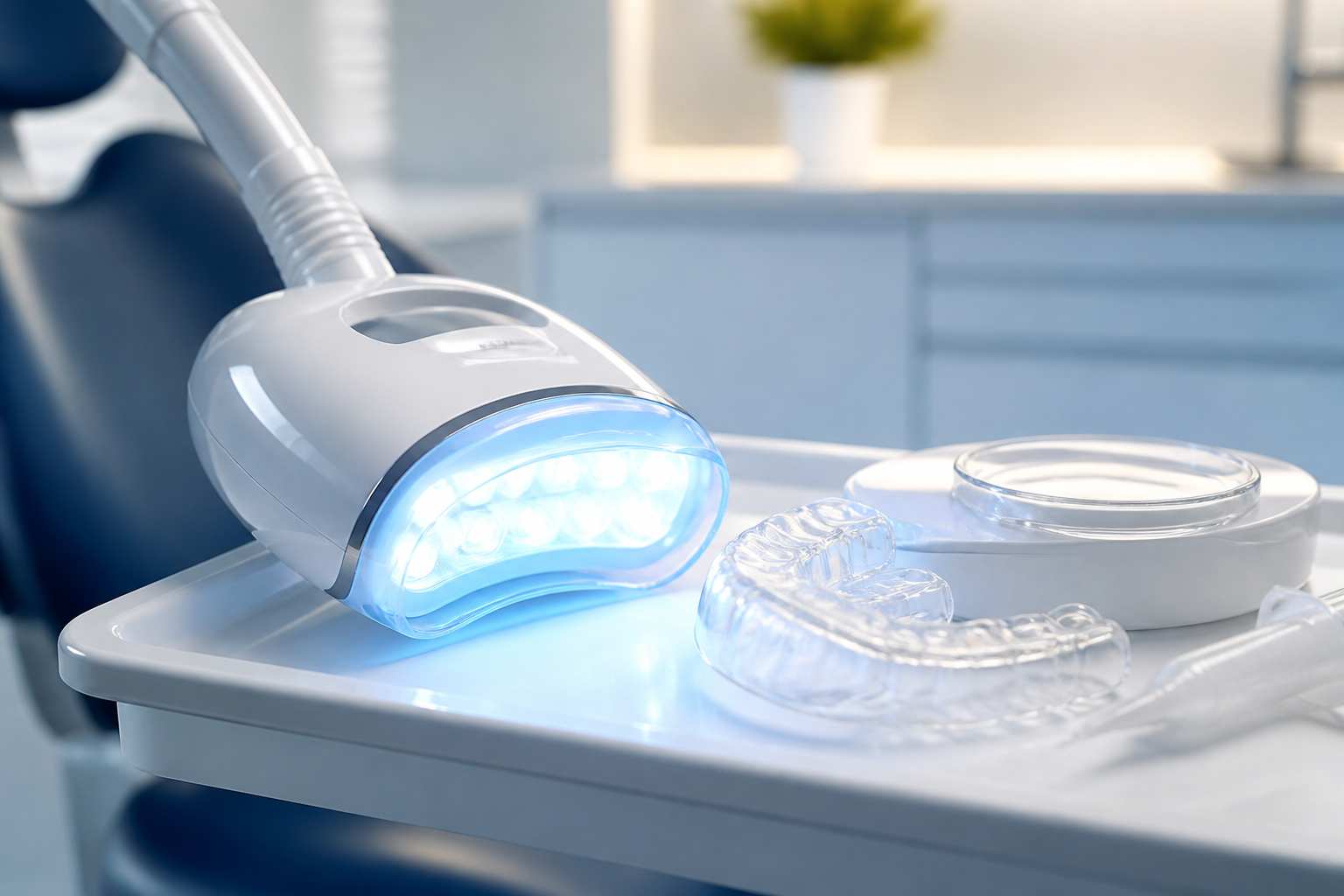
In-chair whitening — sometimes called power whitening or chair-side whitening — is completed entirely at the dental practice in a single appointment of around 60 to 90 minutes.
The dentist applies a high-concentration whitening gel directly to your teeth and may activate it with a light source. Multiple applications can be done within the same session. Results are visible the same day, which is the clear appeal.
The trade-off is sensitivity. The higher-concentration gel and the accelerated process mean some people experience significant tooth sensitivity — it can start during the appointment and linger for a day or two afterward. For anyone whose teeth are already prone to sensitivity, this is worth taking seriously.
In-chair whitening suits someone who wants visible results quickly and doesn’t have pre-existing sensitivity concerns.
Take-home professional whitening
Take-home whitening uses professional-grade whitening agents, but the process is more gradual. Here’s how it works:
Your dentist takes impressions of your teeth and has custom trays made specifically for your mouth. The fit is close and precise — the tray conforms exactly to the shape of your teeth, holding the whitening gel in even contact with each tooth surface.
You wear the trays at home, typically for 30 to 60 minutes each day over one to two weeks. Some people tolerate wearing them overnight — your dentist will advise what’s appropriate for you. The results are comparable to in-chair whitening; they just arrive more gradually.
For many patients, that’s actually the better experience.
Why take-home whitening suits a lot of people
There are genuine advantages to the take-home approach that go beyond just convenience.
Less sensitivity. The lower peroxide concentration, combined with the shorter daily application time, tends to produce significantly less sensitivity than in-chair treatment. For people who already notice sensitivity to cold drinks or sweet food, this makes a real difference.
You control the pace. If your teeth feel sensitive on a particular day, you simply don’t wear the trays. You’re not halfway through a 90-minute in-chair session with no easy exit. The flexibility is real, and most people find it manageable around a regular work schedule.
Reusable trays mean easy top-ups. This is one of the most practical advantages of professional take-home whitening: you keep the custom trays. When you want to refresh your results six or twelve months later, you just purchase more whitening gel. No need to start a whole new whitening course — the trays last for years with normal care.
Done on your schedule. Thirty minutes of tray wear can happen while you’re watching TV, making dinner, or winding down after a long day at Technology Park. You’re not blocking out a 90-minute appointment window and finding parking at a practice.
At Smile Spot, take-home professional whitening is our primary whitening option, and it works well for most patients we see.
Who is a good candidate?
Whitening isn’t for everyone, and it’s worth understanding this before you get started.
Whitening works on natural tooth enamel. It won’t change the colour of crowns, veneers, bridges, or tooth-coloured fillings. If you have visible restorations on your front teeth, whitening the surrounding natural teeth could create a colour mismatch — something worth discussing with your dentist before you begin.
Whitening is also not appropriate if you currently have:
- Untreated decay or gum disease — these need to be addressed first
- Very sensitive teeth or significant exposed root surfaces
- Certain types of intrinsic tooth staining (staining that originates from inside the tooth, which surface whitening can’t address)
A dental check-up before whitening is always worthwhile. It confirms your teeth and gums are healthy enough for the process and means you’re not whitening on top of an underlying issue that needs attention first. If we haven’t seen you recently, we’ll usually recommend a check-up and clean before starting any whitening.
Managing sensitivity
Some degree of sensitivity during whitening is common and temporary. It typically resolves within a day or two of pausing treatment.
If sensitivity is an issue during a take-home whitening course, a few things help:
- Skip a day and rest your teeth before continuing
- Use a sensitivity toothpaste in the days before and during whitening — some patients find this makes a noticeable difference
- Ask about a lower-concentration gel option, which whitens more slowly but more comfortably
- Shorten your daily wear time
The beauty of take-home whitening is that you have these levers to pull. You can slow the process down without starting over.
Maintaining your results
Whitening results aren’t permanent. Teeth naturally re-stain over time from food, drinks, and daily life. Coffee and tea are the most common culprits — and if you’re picking up a flat white from The Promenade every morning, that adds up.
To extend your results:
- Ease up on staining drinks in the first week or two after whitening, when enamel is temporarily more porous
- Rinse with water after coffee or tea when you can
- Maintain regular dental check-ups and cleans, which also remove surface staining
- Do a touch-up with your custom trays every 6 to 12 months
Because the trays are reusable, that top-up is straightforward — you just need a fresh supply of gel.
What about the cost?
Professional whitening costs more than over-the-counter alternatives because it involves a custom process, custom trays, and dental supervision. What you’re paying for is precision, safety, predictability, and longevity — including the ability to top up results cheaply for years using the same trays.
We don’t publish exact pricing online, because the right approach (and what’s involved) depends on your individual situation. We’re happy to talk through costs when you come in or when you call.
If you have dental health cover, ask us about your rebate entitlements — we have HICAPS on-site for on-the-spot claiming, so you’ll know where you stand straight away. Smile Spot is a preferred provider with Bupa Members First Platinum, nib, CBHS, and smile.com.au. For anything outside your fund cover, we offer DentiCare interest-free payment plans.
A note on timing
We’re open Monday to Thursday until 7pm — which works well if you’re commuting from Edinburgh RAAF, driving in from Parafield Gardens or Salisbury, or finishing up at Technology Park before heading home. The Friday hours are 9am to 2pm.
If you’re a UniSA student thinking about whitening before a job interview or graduation later this year, it’s worth booking early — a two-week take-home course needs a little lead time for the custom trays to be made, so the earlier you get started, the more flexibility you have.
Dr Louise Chen completed her BDS at the University of Adelaide and consults in English and Mandarin. If you’d prefer to discuss whitening options in Mandarin, just mention it when you book.
To explore teeth whitening at Smile Spot or find out more about cosmetic dentistry options, call us on (08) 8258 0650 or book online. We’re at 1/3 Coventry Street, Mawson Lakes SA 5095.
Any surgical or invasive procedure carries risks. Before proceeding, seek a second opinion from an appropriately qualified health practitioner.