If you’ve ever been told you need a dental crown, you probably expected the usual routine: one appointment to prepare the tooth and take impressions, a temporary crown to wear for a week or two, then a second appointment to fit the permanent restoration. That’s two visits, time off work, and a fragile temporary you have to be careful with in between.
For a lot of people in Mawson Lakes and the surrounding northern suburbs, that second visit is the hard part. If you’re driving to work from Parafield Gardens or Salisbury, or you’re a shift worker connected to the Edinburgh RAAF base or the Technology Park just up the road, carving out two separate appointment slots during business hours is genuinely difficult. Same goes for students at UniSA’s Mawson Lakes campus juggling classes and part-time work.
At Smile Spot Mawson Lakes, we use CEREC technology to complete the entire process in a single visit. One appointment. Walk in, walk out with a permanent crown.
What is CEREC?
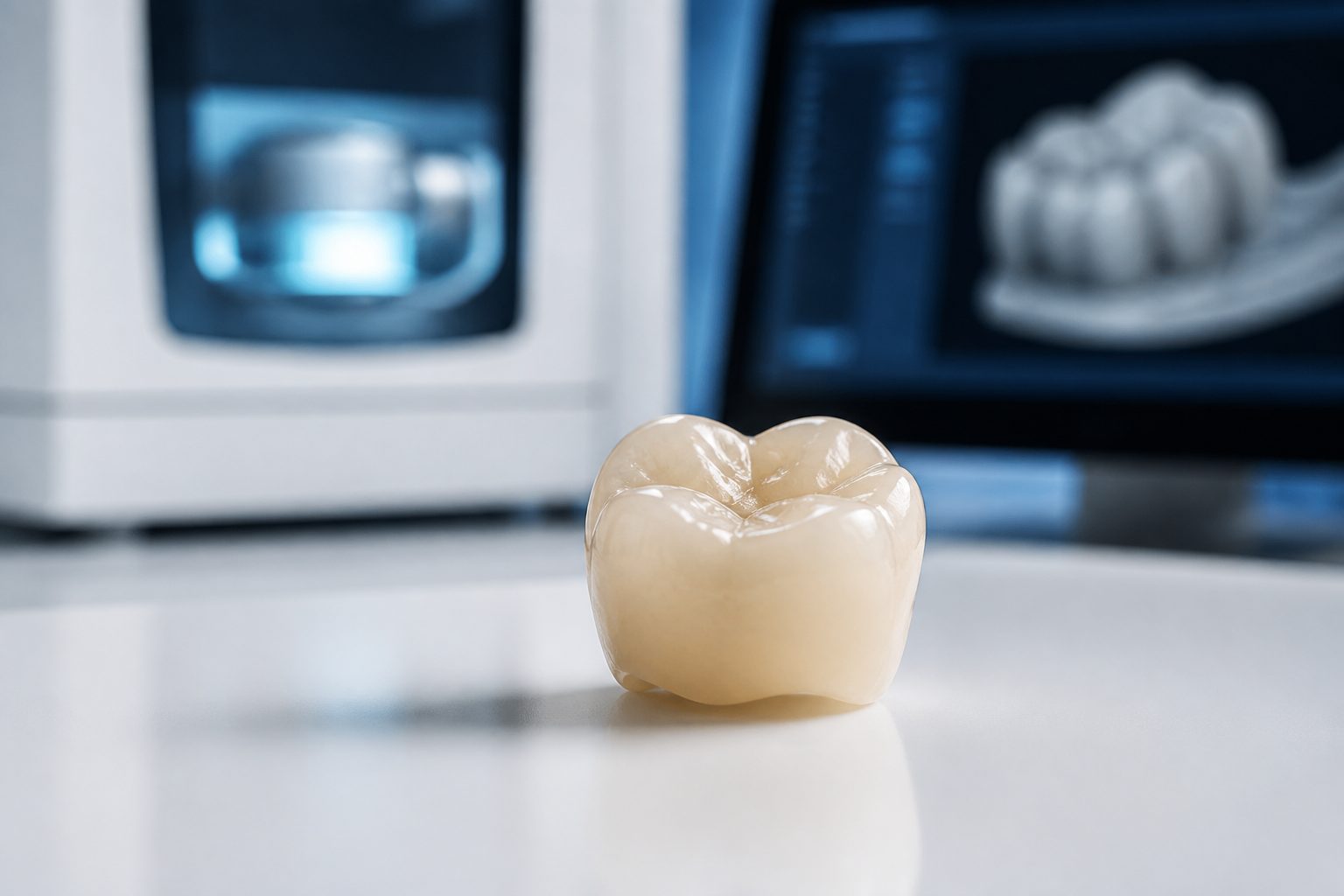
CEREC stands for Chairside Economical Restoration of Esthetic Ceramics. It’s a computer-aided design and manufacturing system that allows your dentist to create a custom ceramic crown, inlay, onlay, or veneer right here in the practice, while you wait.
The technology has been in clinical use for over 35 years and has evolved significantly. The latest-generation CEREC systems create restorations milled from high-quality ceramic blocks that closely mimic the appearance, translucency, and strength of natural tooth structure — designed on screen and fabricated on-site.
The key difference from traditional crowns: everything happens in our practice. There’s no impression going to an external laboratory, no two-week wait, and no temporary crown.
The old way vs. CEREC: what actually changes for you
Traditional crowns require two appointments spread over one to three weeks. At the first visit, your dentist prepares the tooth and takes a physical impression — usually involving trays filled with putty-like material, which most people find uncomfortable. A temporary crown is placed while the permanent one is sent to an offsite laboratory. At the second visit, the temporary is removed and the permanent crown is cemented.
With CEREC, the process is consolidated into a single visit of approximately one and a half to two hours:
- Digital scan. A small intraoral camera takes a precise 3D image of the prepared tooth. No impression trays, no putty, no gagging.
- Computer-aided design. Your dentist designs the restoration on screen, shaping it to fit your bite and match the surrounding teeth — this step happens while you’re in the chair.
- In-practice milling. A milling unit in our practice carves the restoration from a solid block of ceramic. The milling process takes around 15 to 20 minutes. The crown is then polished, colour-matched, and bonded into place.
You walk out with your permanent restoration the same day.
Why this matters for people in Mawson Lakes
This is where CEREC and our evening hours work together. We’re open Monday to Thursday until 7pm, which means you can book a CEREC appointment after work and have the entire process done before dinner. No annual leave burned on a dental appointment. No childcare to arrange for a second visit weeks later. No temporary crown to worry about cracking when you eat.
For the working households in Mawson Lakes, Parafield Gardens, and Ingle Farm — where the median household income is around $100,000 and most families have two incomes to protect — time is as valuable as money. Eliminating a second visit isn’t just convenient; it’s genuinely useful.
For families, CEREC also removes a stressor that doesn’t get talked about enough: temporary crowns are fragile. They’re not designed to last — they’re placeholders. Avoiding that two-week period where you’re being careful about what you eat and hoping the temporary doesn’t come off in the meantime is a meaningful quality-of-life improvement.
What CEREC can create
CEREC isn’t limited to crowns. The same in-practice milling system can fabricate:
- Crowns — full-coverage ceramic restorations for damaged, weakened, or heavily filled teeth
- Inlays — restorations that fit within the cusps of a back tooth, more durable than a large filling
- Onlays — larger restorations that cover one or more cusps, used when a crown isn’t necessary but a filling isn’t sufficient
- Veneers — thin ceramic shells bonded to the front surface of teeth
Your dentist will assess which type of restoration is appropriate for your situation. Not every case calls for CEREC, and we’ll be upfront if a laboratory restoration would suit you better.
The precision advantage
One of the less-discussed advantages of CEREC is what the digital scan replaces. Traditional impressions are taken with putty-like materials that have to set in the mouth — and the material can distort slightly as it sets, particularly at the edges of the preparation where accuracy matters most.
A digital intraoral scan creates a precise 3D model of the prepared tooth and surrounding teeth that can be reviewed on screen before the design process begins. If something looks off, the dentist can identify it immediately and rescan a specific area, rather than discovering the issue when the laboratory restoration comes back two weeks later.
This precision in the design step contributes to a well-fitting restoration — one that seats accurately, seals the margins of the prepared tooth, and functions comfortably with your bite. That said, outcomes depend on individual circumstances, and your dentist will discuss what to expect based on your specific case.
What the ceramic material is actually like
People sometimes ask whether a same-day CEREC crown can really be as good as one made in a laboratory. The ceramic blocks used in CEREC milling are high-quality dental materials — the same classes of ceramic used in laboratory-made restorations, pressed into standardised blocks for precision milling.
The finished restoration is hard, stain-resistant, and tooth-coloured. The colour matching process allows your dentist to select from a range of shades to blend with adjacent teeth. For most people who haven’t already had a CEREC crown, this comes as a surprise — they expect something that looks temporary or artificial, and instead get something that looks like a tooth.
Is CEREC right for every situation?
Not always. Some complex cases — particularly those involving very large restorations, significant aesthetic demands across multiple teeth, or certain jaw and bite relationships — may still benefit from a laboratory-fabricated restoration. A specialist laboratory technician can hand-layer ceramics in ways that the milling process can’t replicate for highly complex aesthetic work.
Your dentist will give you an honest assessment. If CEREC is the right approach for your tooth, we’ll say so and explain why. If a laboratory restoration would serve you better, we’ll tell you that instead.
Book a same-day crown consultation
If you’ve been told you need a crown, or if you’ve been putting off getting one because you can’t face the two-appointment process, it’s worth finding out whether CEREC is suitable for your situation.
Book at Smile Spot — call (08) 8258 0650 or book online. With appointments until 7pm on weeknights, you won’t need to take time off work.
Any surgical or invasive procedure carries risks. Before proceeding with treatment, you should seek a second opinion from an appropriately qualified health practitioner. Individual results may vary.