If you’ve been thinking about straightening your teeth, you’ve almost certainly hit the Invisalign versus braces question. It comes up in almost every orthodontic consultation we do here at Smile Spot Mawson Lakes — and for good reason. These are genuinely different approaches, and the right choice depends on your specific teeth, your lifestyle, and what you actually want to achieve.
The honest answer is that neither is universally better. There are situations where traditional braces will produce a better result, situations where Invisalign is the more practical choice, and plenty of cases where either would work just fine. This post walks you through the key differences so you can walk into a consultation with a clearer head.
How Traditional Braces Work
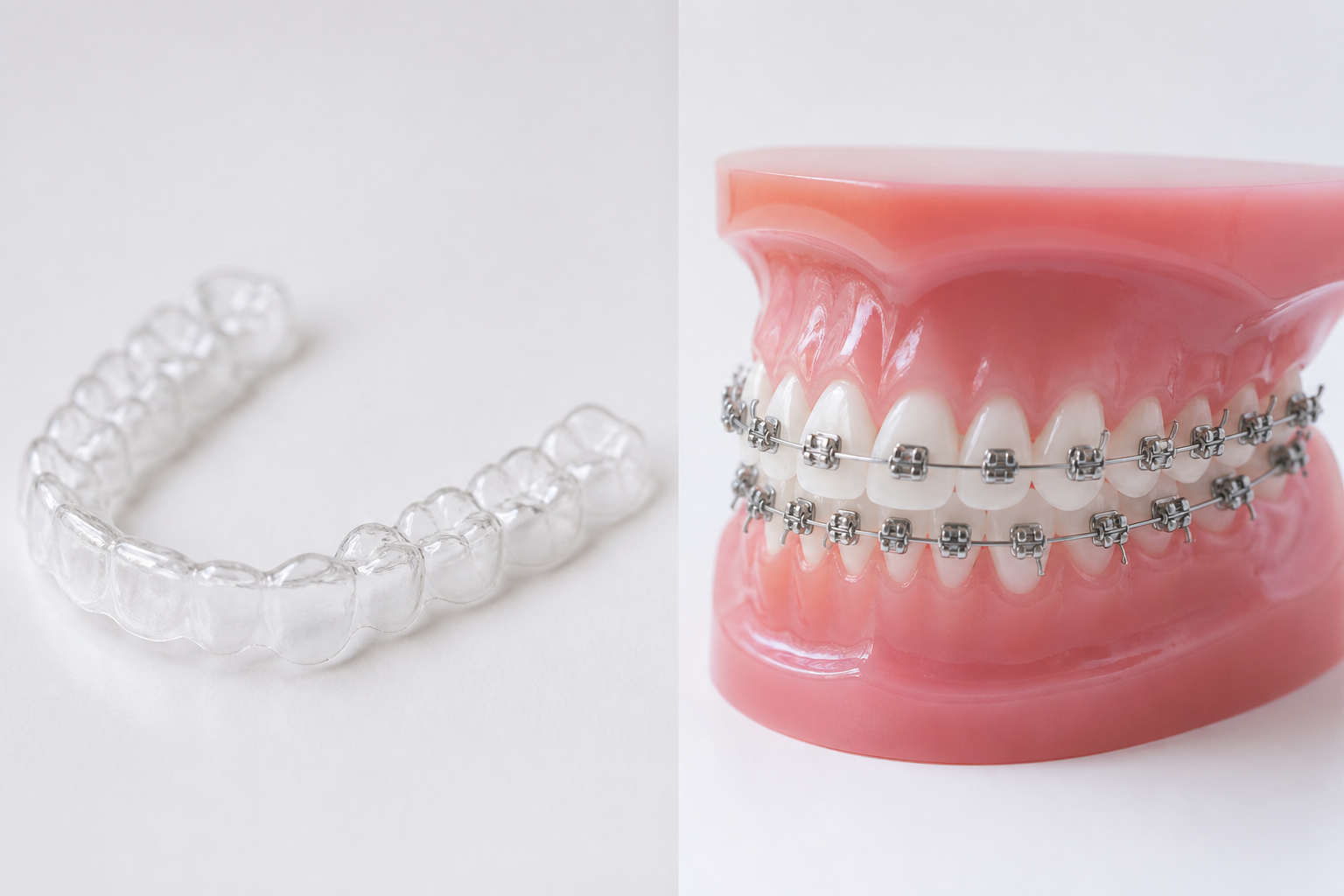
Traditional braces use metal brackets bonded to the front of each tooth, connected by a wire that runs through all the brackets. Your dentist adjusts the wire at regular appointments — typically every four to six weeks — progressively applying controlled force to move teeth into the desired position.
Modern braces are considerably lower-profile and more comfortable than they used to be, but they’re still visible, still fixed in place, and still require adjustments to what you eat and how you clean your teeth.
Ceramic braces follow exactly the same mechanism but use tooth-coloured brackets, making them noticeably less visible than metal. They cost a little more and are slightly more fragile, but for patients who want the control of fixed braces with less visibility, they’re worth considering.
How Invisalign Works
Invisalign uses a series of custom clear aligners — thin, transparent trays made from smooth plastic — designed specifically for your teeth. You wear each set of aligners for one to two weeks before moving to the next set in the series. Each new tray makes small, incremental adjustments that gradually shift your teeth.
The aligners are removable. You take them out to eat, drink anything other than water, and brush and floss your teeth. The rest of the time — including while you sleep — you wear them. Invisalign recommends 20 to 22 hours per day for treatment to progress as planned.
The Key Differences
Visibility
Metal braces are clearly visible. Clear aligners are genuinely difficult to notice in normal conversation, though they’re not completely invisible at close range.
For many adults, this is the deciding factor. We see a lot of patients at our Mawson Lakes practice who work at Technology Park Adelaide or nearby Edinburgh RAAF base — engineers, defence contractors, project managers — for whom the thought of sitting across a boardroom table with a mouth full of metal brackets is a genuine barrier to treatment. Clear aligners make that barrier disappear.
Eating habits
With braces, certain foods need to go: hard foods like raw carrots, crusty bread, or corn on the cob can damage brackets; sticky foods like toffee or chewy lollies can pull wires. The restrictions aren’t dramatic, but they require ongoing thought — every meal, every snack.
With Invisalign, you remove the aligners to eat, which means no dietary restrictions at all. The catch is that you need to brush your teeth before reinserting the aligners after meals. For some people that’s a minor inconvenience; for others it’s genuinely hard to keep up with — worth being honest with yourself about before you commit.
Cleaning
Braces require more careful cleaning. Food traps around brackets and wires, flossing means threading past the wire at each gap, and inadequate cleaning over time can leave decalcification marks on enamel around the brackets. Interdental brushes and water flossers help significantly.
With Invisalign, you clean your teeth normally with the aligners out. You do need to clean the aligners themselves — rinsing them regularly and gently brushing them to prevent yellowing and odour — but on balance, most patients find oral hygiene easier with aligners than with fixed braces.
Appointment frequency
Braces require in-chair check-ups every four to six weeks for wire adjustments. Invisalign typically requires check-ins every six to twelve weeks, depending on how treatment is progressing.
This matters a lot for busy people. If you’re commuting from Salisbury, Para Hills, or Paralowie and juggling work hours, fitting in monthly appointments can be genuinely difficult. Fewer appointments is a real advantage — and because we’re open until 7pm Monday to Thursday (later than most Adelaide practices, which close at 5pm), you can often book an evening slot without taking time off work.
Treatment time
Both approaches typically require somewhere between 12 and 24 months for moderate cases. Minor issues can sometimes be addressed more quickly; complex cases take longer. Your dentist will give you a more specific estimate after examining your teeth and understanding what you want to achieve.
Who Tends to Do Well with Invisalign
Invisalign works well for mild to moderate crowding, spacing issues, and certain bite corrections. It’s particularly suited to adults who are motivated to wear the aligners consistently, who care about how they look during treatment, and who want to eat normally throughout.
The key word is motivated. Clear aligners only work if you wear them as directed. If they’re regularly sitting in their case for hours at a time, treatment won’t progress as planned. This isn’t a criticism of the system — it’s just an honest assessment of what it requires. Some people find the discipline straightforward; others find it harder than they expected.
We find Invisalign particularly popular with the young professionals in Mawson Lakes and surrounding suburbs like Ingle Farm and Pooraka — people in their 30s who didn’t get treatment as teenagers and are now thinking about it before a job change, a wedding, or simply because they’ve finally decided it’s time. The idea of going through treatment without anyone at work really noticing is a significant drawcard.
UniSA students at the Mawson Lakes campus also ask about Invisalign often, particularly those heading into placement year or job interviews. Treatment that doesn’t announce itself is appealing when you’re trying to make an impression professionally.
When Braces May Be the Better Option
Complex orthodontic cases — significant bite corrections, severe crowding, or movements that require very precise control over individual teeth — are often better managed with traditional braces. Fixed appliances apply force continuously and give the practitioner more direct control over specific tooth movements.
For some teenagers, braces can also be more reliable for a straightforward reason: compliance. The appliance is fixed, so it’s working regardless of whether the patient remembers to put their aligners back in after lunch. If you have a teenager who’s genuinely motivated and responsible, Invisalign can work well. If you’re not sure they’ll wear the trays consistently, fixed braces remove the question entirely.
We see a lot of families from Parafield Gardens and Paralowie considering orthodontics for their teenagers. One thing worth discussing: if your teen plays contact sport on the weekends, a properly fitted mouthguard is important regardless of whether they have braces or aligners. We can talk through that as part of the consultation.
A Note on Age
Invisalign has become increasingly popular with adults in their 30s, 40s, and older — people who feel that traditional braces aren’t practical for their professional or personal circumstances. There’s genuinely no upper age limit for orthodontic treatment, and adult patients often do very well with clear aligners.
For teenagers, both options are viable. Invisalign Teen is a version designed specifically for adolescent patients — it includes compliance indicators (a small dot on each aligner that fades with wear, so you can track whether the trays are actually being worn) and replacement aligners for the ones that inevitably get lost.
Getting Started: What a Consultation Looks Like
The only way to know which option genuinely suits your situation is to have your teeth assessed in person. Not every case is appropriate for Invisalign, and a responsible approach involves being clear with you about that — rather than just recommending whichever option is more popular or convenient.
At a consultation, we look at your bite, the degree of crowding or spacing, and the overall complexity of what needs to move. Dr Sunny — our principal dentist and the person with the most experience in orthodontic cases at Smile Spot — will give you a straightforward recommendation based on what he sees, not a sales pitch. Dr Sunny speaks Punjabi and has a strong connection with many patients from the Punjabi-speaking community across Mawson Lakes and Parafield Gardens, which can make these conversations easier if English isn’t your first language. Dr Louise Chen (that’s me, the author of this post) also sees patients for orthodontic consultations and speaks Mandarin.
We have HICAPS available for on-the-spot private health claiming, and we’re preferred providers for Bupa Members First Platinum, nib, CBHS, and smile.com.au — so if you have health insurance, we can check your orthodontic entitlements on the spot. For patients without cover or who want to spread the cost, we offer DentiCare interest-free payment plans.
For more on what we offer, see our Invisalign page or our cosmetic dentistry overview. If you haven’t seen us before and want to start with a general check-up, our dental checkups page covers what’s involved.
Ready to find out which option suits your teeth? Book a consultation at Smile Spot Mawson Lakes — we’re at 1/3 Coventry Street, Mawson Lakes SA 5095. Call (08) 8258 0650 or book online. We’re open Monday to Thursday 10am–7pm and Friday 9am–2pm.
Any surgical or invasive procedure carries risks. Before proceeding, seek a second opinion from an appropriately qualified health practitioner.