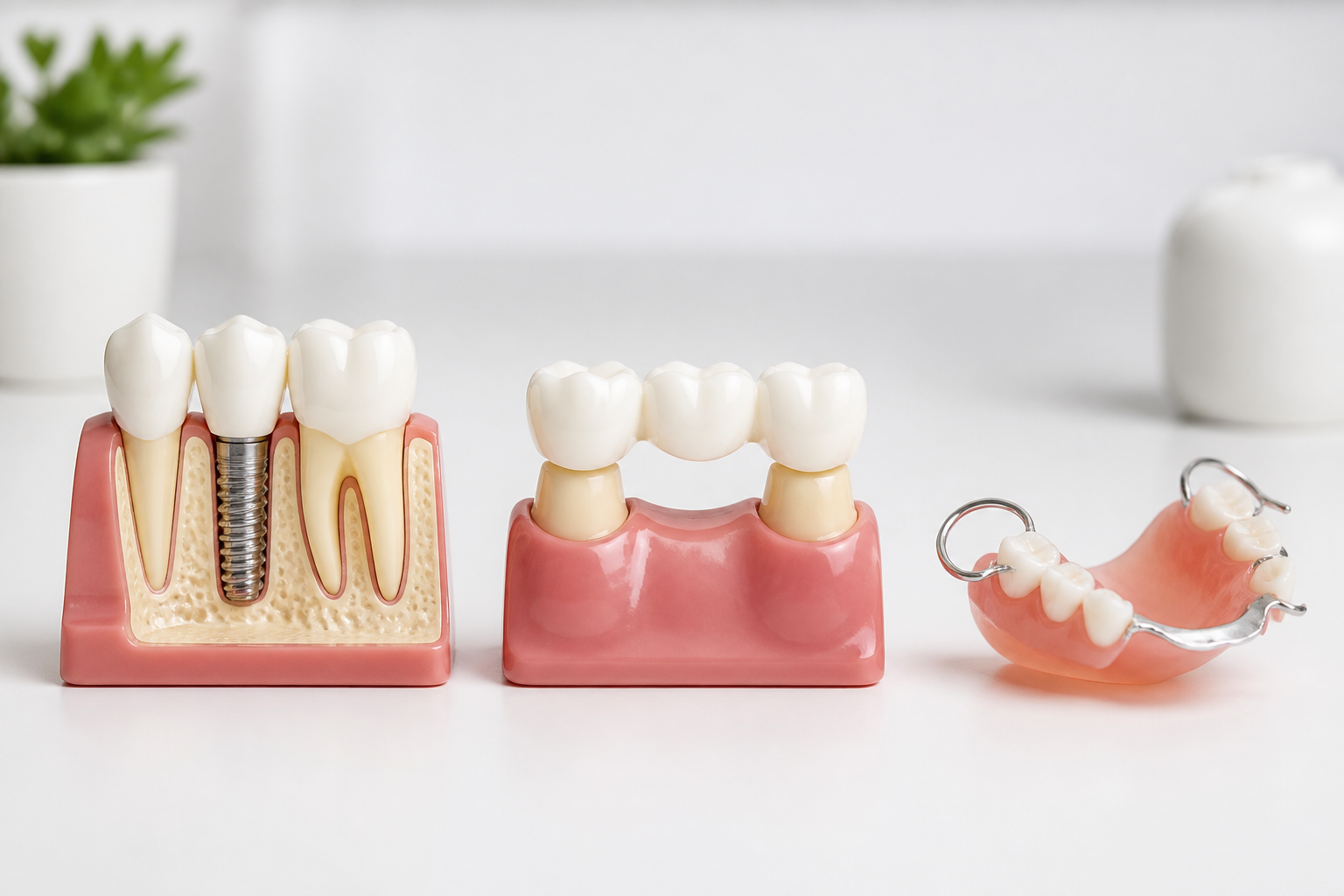
When you lose a tooth — or need one extracted — you’re usually presented with three main options: a dental implant, a bridge, or a denture. Each has genuine advantages and genuine drawbacks. The right choice depends on your specific situation, not on which option a practice happens to promote most heavily.
At Smile Spot Mawson Lakes, we see patients from right across the northern suburbs — Parafield Gardens, Paralowie, Salisbury, Ingle Farm, Para Hills, and Pooraka — and the question we get asked most often at a tooth-replacement consultation is some version of: “Just tell me which one is best.” The honest answer is that it depends. But we can explain what it depends on, so you walk in knowing what questions to ask.
Here’s a straightforward comparison to help you understand what’s involved with each option.
The quick comparison
| Dental Implant | Bridge | Denture | |
|---|---|---|---|
| What it is | Titanium post surgically placed in the jawbone, topped with a crown | False tooth attached to crowns cemented onto adjacent teeth | Removable prosthetic — partial (some teeth) or full (all teeth) |
| Longevity | 15–25+ years, often lifetime with proper care | 10–15 years typically | 5–10 years before reline or replacement |
| Approximate cost (single tooth) | $3,000–$6,500 | $2,500–$5,000 | $500–$2,500 (partial) |
| Affects adjacent teeth? | No | Yes — neighbouring teeth are filed down for crowns | Partial dentures clasp onto adjacent teeth |
| Bone preservation | Yes — stimulates the jawbone | No — bone loss continues under the false tooth | No — bone loss continues |
| Feels like a natural tooth? | Closest to natural | Reasonably close | Less natural, can feel bulky |
| Surgery required? | Yes | No | No |
| Treatment timeline | 3–6 months (including healing) | 2–3 weeks | 2–4 weeks |
Dental implants — when they make sense
Dental implants are the closest thing to replacing a natural tooth. The titanium post integrates with your jawbone over several months, creating a stable foundation for a crown that looks, feels, and functions like a real tooth. You brush it, floss it, and forget about it.
The main advantages are longevity and independence — an implant doesn’t rely on neighbouring teeth for support, and it’s the only option that prevents the bone loss that naturally occurs when a tooth is missing. For a younger patient, that matters enormously. Mawson Lakes has a median age of just 33, and we see a lot of working professionals from Technology Park Adelaide and Defence personnel from Edinburgh RAAF who lose a tooth in their late twenties or early thirties. For someone with potentially 40 or 50 years ahead of them, an implant that lasts a lifetime is a very different proposition from a bridge that may need replacing twice over that same period.
Dr Sunny — our principal dentist and a Griffith University BDSc graduate — has a particular focus on implant dentistry and orthodontics, and he’s one of the reasons patients from Parafield Gardens and Paralowie make the trip to Coventry Street rather than going wherever is closest. Implant treatment requires both surgical precision and a careful eye for aesthetics. Many patients who might otherwise be referred to a specialist elsewhere can be treated right here at Smile Spot.
The downsides are cost (implants are the most expensive option upfront), the need for surgery, and a longer treatment timeline. You also need adequate bone volume in the jaw — if bone has already been lost after an extraction, a bone graft may be needed first, which adds time and cost. All of that gets assessed at your initial consultation before any decisions are made.
Implants tend to make the most sense when you’re replacing one or two teeth, the adjacent teeth are healthy (so you’d rather not file them down for a bridge), and you want a long-term solution you don’t have to think about.
Bridges — when they make sense
A dental bridge literally bridges the gap left by a missing tooth. The false tooth (called a pontic) is fused between two crowns that sit on the teeth on either side of the gap.
Bridges are a solid option when the adjacent teeth already have large fillings or crowns and would benefit from being crowned anyway — in that scenario, you’re addressing two problems at once. They’re also a good choice for patients who aren’t suitable candidates for implant surgery, or who prefer to avoid a surgical procedure entirely.
The main drawback is that healthy adjacent teeth must be permanently altered — filed down to accommodate the supporting crowns. Once that enamel is removed, those teeth will always need crowns. The bridge also doesn’t prevent bone loss in the area where the tooth is missing, and if one of the supporting teeth develops a problem down the line, the entire bridge may need to be replaced.
Cost sits in the middle — less than an implant, more than a denture. Treatment takes two to three weeks, with no surgery involved, which makes it an appealing option for patients who need a faster resolution. We can also pair bridge treatment with our same-day crowns service where appropriate, which can reduce the number of appointments you need — useful if you’re catching a train from Mawson Interchange and fitting appointments around a full work schedule.
Dentures — when they make sense
Dentures are the most affordable and least invasive option. A partial denture replaces one or several missing teeth and clips onto your remaining teeth. A full denture replaces all teeth in an arch.
Modern dentures are significantly better than what your grandparents wore. Materials are more natural-looking, fit can be quite precise, and for many patients — particularly those replacing multiple teeth — a well-made partial denture is a perfectly functional solution.
The honest downsides: dentures are removable, which some people find inconvenient or self-conscious about. They can affect speech and taste (full dentures cover the palate). They need periodic relining as the jawbone changes shape over time. And they don’t prevent bone loss. For a younger person, these trade-offs often feel more significant than for someone in their seventies.
One thing we’ve noticed in our community — Mawson Lakes is home to a lot of people who’ve built their careers and social lives here, including many from Vietnamese, Mandarin, and Punjabi-speaking backgrounds where a confident smile carries real weight in professional and social settings. We raise this not to oversell any particular treatment, but because it’s a genuine factor in how patients think about their options. Dr Sunny speaks Punjabi and regularly sees patients who prefer to discuss complex treatment decisions in their first language — it makes a real difference when you’re trying to fully understand a significant clinical choice. Whatever your situation, we’ll help you find something that works for your life.
Dentures make the most sense when cost is the primary concern, when multiple teeth need replacing, when surgery isn’t an option due to health reasons, or as an interim solution while saving toward implants.
There’s no universally “best” option
Anyone who tells you one option is always the best isn’t giving you the full picture. A 27-year-old Defence worker at Edinburgh RAAF who loses a front tooth in an accident has very different considerations from a 72-year-old Salisbury resident who needs to replace several back teeth. Age, bone health, the condition of surrounding teeth, medical history, budget — all of it matters.
The factors that tend to shape the recommendation most are:
- How many teeth are missing and where they are in the mouth
- The condition of your remaining teeth — healthy adjacent teeth shouldn’t be sacrificed unnecessarily for a bridge
- Your jawbone health — adequate bone volume is needed for implants to succeed
- Your overall health — some medical conditions and medications affect how implants heal
- Your budget — both upfront and over the long term (implants cost more initially but typically last longer, which affects the lifetime cost comparison)
- Your preferences — some people simply don’t want surgery, and that’s a completely valid consideration
We’re a QIP accredited practice, which means our clinical processes, record-keeping, and patient care standards are independently verified. That matters when you’re making a treatment decision that’ll affect you for years.
Making it accessible
Cost is a real barrier for a lot of families when it comes to implant treatment. We offer DentiCare interest-free payment plans to help spread the cost, which can make implants genuinely accessible for patients who’d otherwise default to a less suitable option purely on upfront price. If you’re in Parafield Gardens or Paralowie and have been putting off a consultation because you’re worried about cost, it’s worth coming in first — you may have more options than you think.
We’re also a Bupa Members First Platinum provider, and a preferred provider for nib, CBHS, and smile.com.au. We accept all major health funds, with HICAPS on-the-spot claiming so you know exactly what you’re out of pocket before you leave.
Getting here is easier than you might think
Our practice at 1/3 Coventry Street, Mawson Lakes is right near the Mawson Interchange on the Gawler rail line — which makes us accessible from Salisbury and stations north, not just for people who drive. If you’re coming through from Ingle Farm or Para Hills via Main North Road, there’s parking nearby. Evening appointments are available Monday to Thursday until 7pm, which means most working patients — whether you’re a shift worker, a UniSA student, a Defence personnel member, or a professional at Technology Park who can’t easily duck out during the day — can find a time without having to take leave.
What to expect at your consultation
Come in and Dr Sunny will assess your specific situation — the gap, the surrounding teeth, your bone health, and your medical history. He’ll explain which options are realistic for you and give you honest advice based on your individual case. You’ll also get a clear picture of what each option involves in terms of appointments, timeline, and cost — including what your health fund covers and what DentiCare payment options look like if cost is a factor.
The right answer for you might be immediately obvious, or it might take a proper assessment to determine. Either way, you’ll leave the consultation with a clear understanding of your choices — not a sales pitch.
At Smile Spot Mawson Lakes, we offer dental implants, bridges, and dentures as part of our general dentistry services.
Book at Smile Spot — call (08) 8258 0650 or book online.
Smile Spot Mawson Lakes — 1/3 Coventry Street, Mawson Lakes SA 5095. Open Monday–Thursday 10am–7pm, Friday 9am–2pm.
Any surgical or invasive procedure carries risks. Before proceeding, seek a second opinion from an appropriately qualified health practitioner. Individual results may vary.